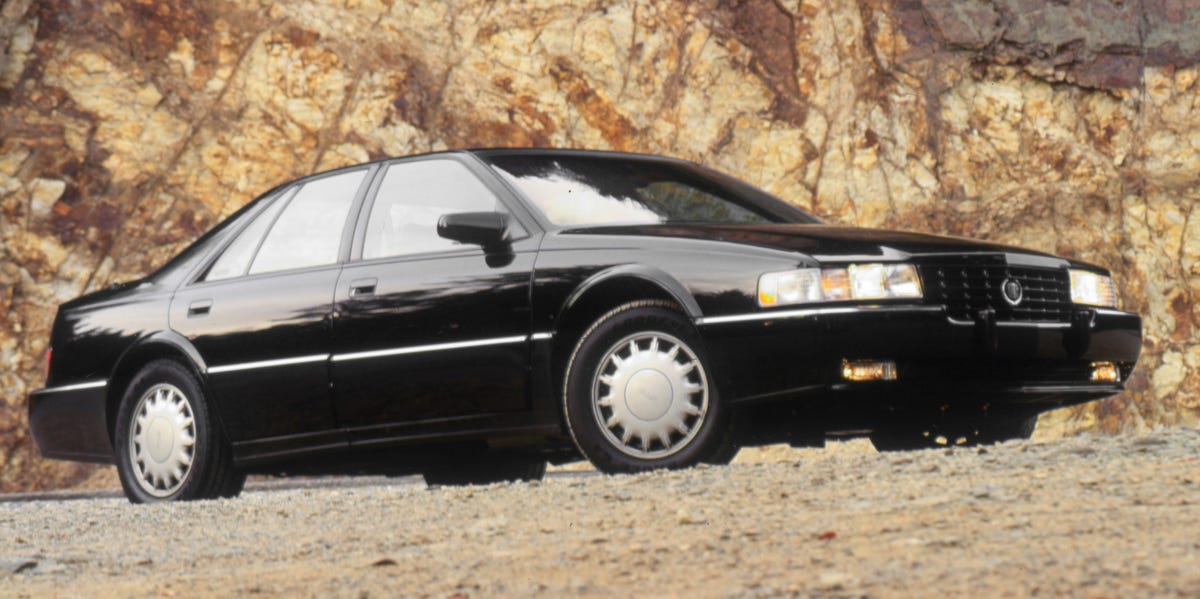
From the archive: If at first you don't succeed... Since its 1976 debut, the Cadillac Seville's mission has been to win back some of the Americans who, in increasing numbers, were buying imported luxury cars. The approach was simple. Mainstream Cadillacs were big, flashy, and soft. So Cadillac made the Seville smaller, more subtle, and tauter.
The result was a successful failure. Despite its departures from the Cadillac norm, the Seville was still too glitzy and too slow to compete with the imported competition. On the other hand, it did find plenty of buyers who simply wanted a smaller, sleeker Cadillac.
The second- and third-generation Sevilles achieved no more success against the imports than the original. But the fourth-generation 1992 model, especially the Seville Touring Sedan (also known as STS) we've tested here, may finally fulfill its mission and win back some of those American luxury-car defectors.
 View Price on Amazon
For starters, this is the best-looking Seville ever. Chief exterior stylist Richard Ruzzin and his Cadillac team have spawned a design with long flowing lines that combine a contemporary aerodynamic look—yielding a 0.33 drag coefficient—with a broad-shouldered crispness that's distinctly American.
From the front, the Seville presents a fresh face incorporating only a few traditional cues that reveal its Cadillac bloodline. Even the brightwork is applied with taste and discrimination. Parked next to a Mercedes 300, a BMW 735i, or a Lexus LS400, this Seville looks distinctive but very much in the proper company.
More important than the new Seville's exterior styling is the new interior-decorating philosophy that Cadillac brings to this car. For although the previous model was reasonably clean and smooth from the outside, when you opened its doors, you were overcome by tiny, shiny switches scattered haphazardly about a boxy dashboard, enough fake-looking wood to stock the contact-paper aisle in the local Builders' Mart, and instruments scattered throughout the cockpit.
All of these elements have been banished from the new model. Instead, we find a smooth, flowing instrument panel, black switchgear, and a white-on-black round tachometer and speedometer set squarely in front of the driver. The digital information center is now to the left of the main instruments rather than being buried at the bottom of the central console. And although there's still wood trim, it now keeps the look of the real article, thanks to fewer, larger, and simpler panels and a less glossy finish. Finally, there's a general softening to all of the elements, which gives this interior the organic look that the Seville's targeted buyers seek in the luxury imports.
The new interior also offers more room now, due primarily to a three-inch wheelbase stretch that has gone mostly into additional rear-seat leg room. Shoulder and hip room are also more generous, thanks to the 1992 model's 2.4-inch increase in overall width. The result is a car that now seems as roomy as its competitors.
Unfortunately, the rear seating position is a little low, basically because the Seville, overall, is on the low side, measuring 54.0 inches high. That's up a fraction from last year's car but still much lower than most foreign competitors (a Mercedes 300E is 57.1 inches high).
Source: caranddriver.com

