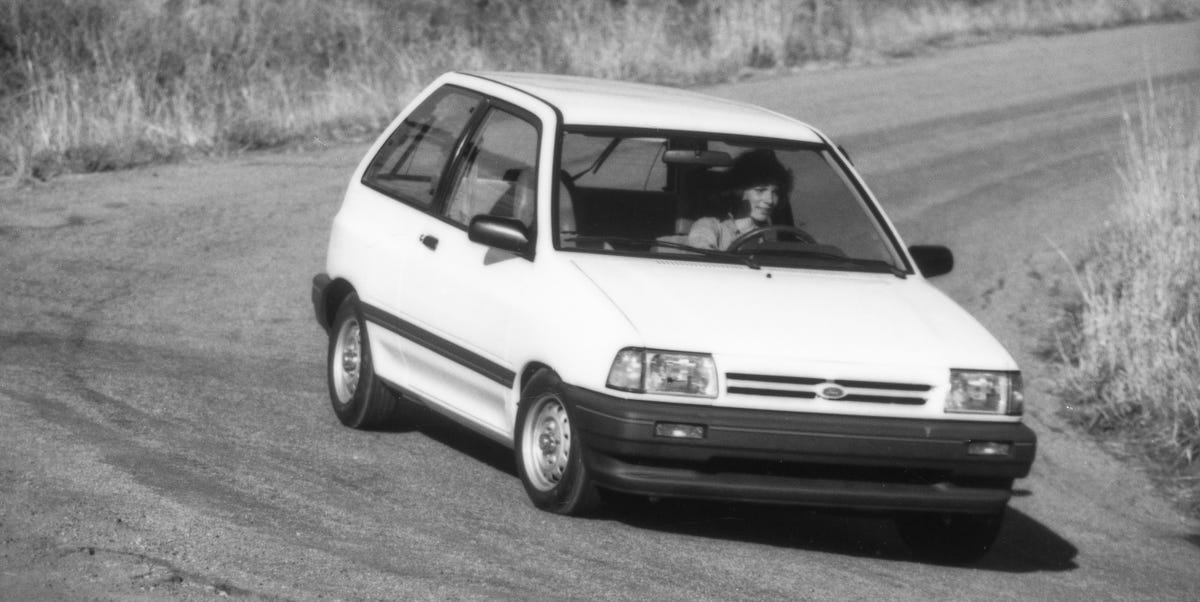
The perfect car for yuppies-in-training. From the May 1987 issue of Car and Driver. Don't be fooled by the current resurgence of big cars with powerful engines. Although many Americans are only too happy to guzzle today's cheap and plentiful fuel as they return to yesterday's automotive values, it's clear that others have developed a lasting affection for small, economical cars.
It used to be that all such cars were outfitted sparely and priced inexpensively, but most of them have evolved upmarket over the years to suit the tastes of their growing customer base. In the meantime, the demand for truly entry-level machines has remained strong, so a fresh brood of econoboxes is rolling into the void left by the upward mobility of the last generation.
The thriftmobiles from Hyundai and Yugo have attracted much of the attention in the sub-$6000 class, but they are hardly alone. The Toyota Tercel and the Chevrolet Sprint predated them, and, this year, the Subaru Justy and the Volkswagen Fox have also joined the lowball ranks. And this is only the beginning. The marketing seers at Ford predict that the penny-pinching class will grow to fourteen entries by 1988, with combined sales of half a million units.
 View Price on Amazon
Although many of the buyers of these cars belong to the lower strata of the nation's demographic profile, Ford's marketers believe that an increasing number of them will be young people with above-average incomes and educations. Such customers are worth a lot to a carmaker, for their automotive tastes are likely to escalate as they age and prosper. Every car company in the world wants to bring such customers into its fold as early as possible.
Ford's latest means for accomplishing this end is the 1988 Festiva (pronounced with the accent on the second syllable), which is being introduced this spring. To keep its price low, the Festiva is manufactured by Kia Motors in South Korea, where the workers are as diligent as carpenter ants and make about as much money. Kia, in which Ford has a ten-percent stake, is one of Korea's top three automakers. However, like most Korean cars, the Festiva was designed elsewhere, in this case by Ford's other Asian partner, Mazda.
Given its parents, it's no surprise that the Festiva is a thoroughly modern small car. A transversely mounted engine drives the front wheels, and a rack-and-pinion mechanism points them in the desired direction. Power-assisted front discs and rear drums handle the braking chores. The Festiva's unitized body and chassis are supported by MacPherson struts in front and a trailing twist axle in the rear.
The Festiva's engine is manufactured by Mazda, and its four cylinders together displace 1324 cc. Like most contemporary powerplants, it has an iron block, an aluminum head, and a belt-driven single overhead camshaft. An electronically controlled carburetor keeps the fuel-air mixture in the right proportions to satisfy the three-way catalyst; it also shuts off the fuel flow during deceleration. The engine is no high winder, developing 58 horsepower at 5000 rpm and 73 pound-feet of torque at 3500.
If those figures fail to impress you, consider that the Festiva weighs only 1820 pounds—and we're referring to the feature-laden LX model, equipped with optional air conditioning. The LX can reach 60 mph from rest in 13.2 seconds and cover the standing quarter-mile in 18.9 seconds at 72 mph, which is certainly quick enough to keep pace with the traffic flow.
Source: caranddriver.com

