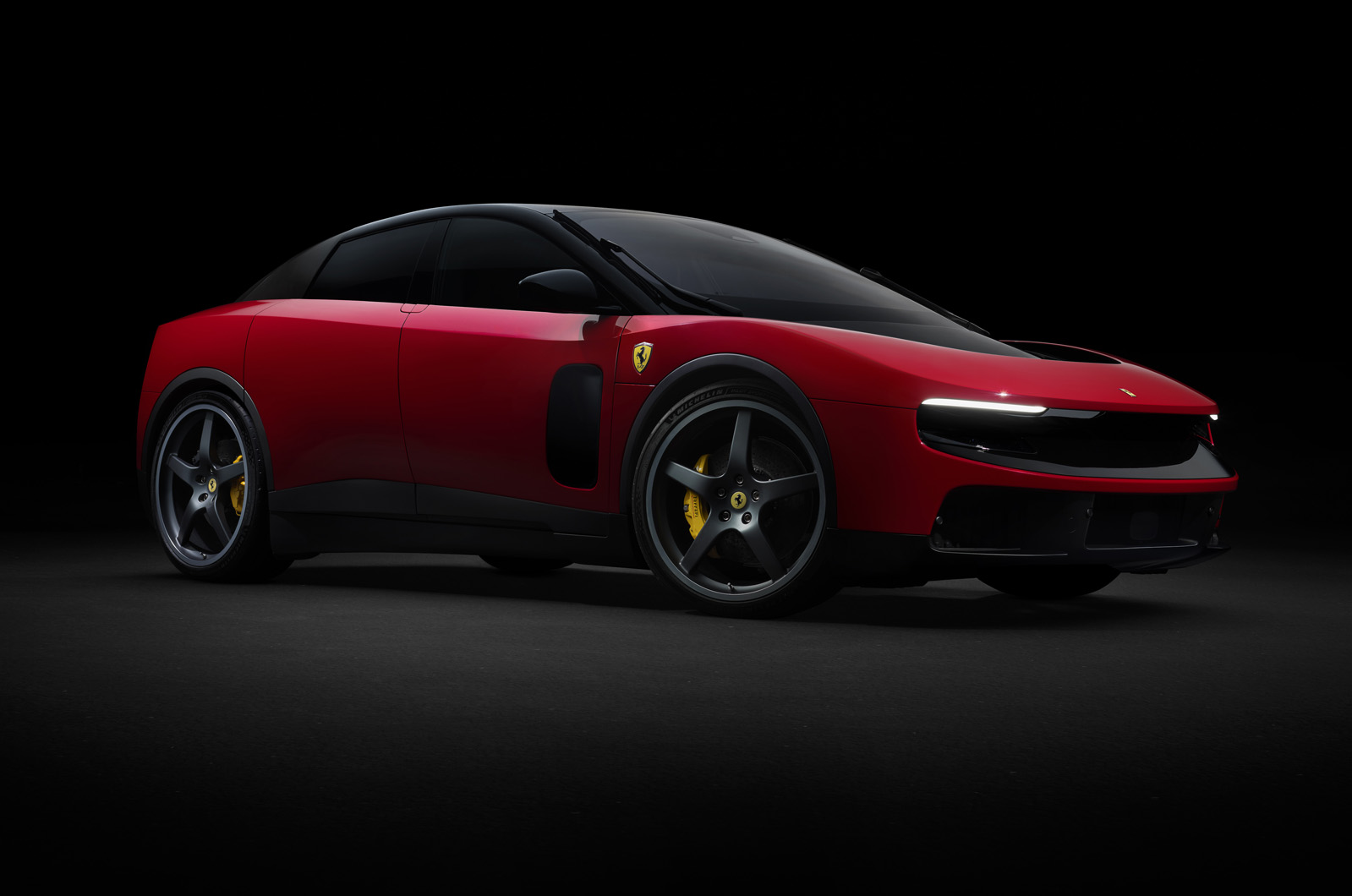
Ferrari has revealed the exterior design and full technical details of its new Luce electric car. Ferrari’s second five-door car (after the Purosangue) and its first five-seater will go on sale priced at around $440,000, with US deliveries set for spring 2027.
The Luce has four electric motors, one for each wheel, making a combined 1036 horsepower, with a 122kWh battery giving it an estimated range of 329 miles (subject to homologation).
In terms of performance, Ferrari says the Luce will be able to reach 60mph from rest in 2.5 seconds, travel from 0-77mph in 6.8 seconds - making it one of the firm’s fastest-accelerating models yet – and go on to a 192mph top speed.
It’s also the firm’s largest car yet: at 197.6 feet the Luce is 2.1 feet longer than a Purosangue, while measuring 78.7 feet wide across the body, and 60.6 feet high, 1.8 feet lower than its V12 sibling - with a 116.1 feet wheelbase.
 View Price on Amazon
The Luce’s design is primarily the work of LoveFrom, the design agency founded by industrial designers Sir Jony Ive – best known for designing the iMac, iPhone and iPad during his time at Apple – and Mark Newson. Ferrari has used design houses such as Pininfarina, Bertone and Zagato before, but it says that its relationship with LoveFrom has helped it think radically.
Members of the LoveFrom team, which has studios in San Francisco and London, have also been based in Ferrari’s offices at Maranello. “We've been working hand in glove with Ferrari for the last six or seven years,” Newson said at the Luce’s launch in Rome. “It’s safe to say that we've been completely embedded within the Ferrari organisation.“
The Luce is a five-door hatch, with aft-hinged rear doors and a cab-forward design – the distance from driver’s seat to front axle is the same as in the 296 GTB – which lends the car a spacious interior.
Rather than the focus of its styling being on downforce as would usually be the case with Ferraris, more attention here has been paid to aerodynamics. The design theme is for it to resemble a two-piece body; the black glassy volume contained within a colored outer shell, is not dissimilar to the way the 12Cilindri’s glass and gloss black volumes look inserted inside its body panels. “You might call it a glasshouse, or we like to call it a passenger cell,” said Newson. “Those things are intrinsically connected, but we like the idea of them as separate design elements.”
Source: autocar.co.uk