The Overlander's Bible: Mastering Traction Where the Road Ends
For the average driver, a tire is a commodity. For the overlander, a tire is a lifeline. When you are 50 miles from the nearest cell tower, crossing a washboard desert or a muddy mountain pass, your tire pressure is the only thing standing between a successful expedition and a satellite-rescue call. In this 3,000-word tire guide, we go off the grid to explain the dark art of off-road traction mastery.
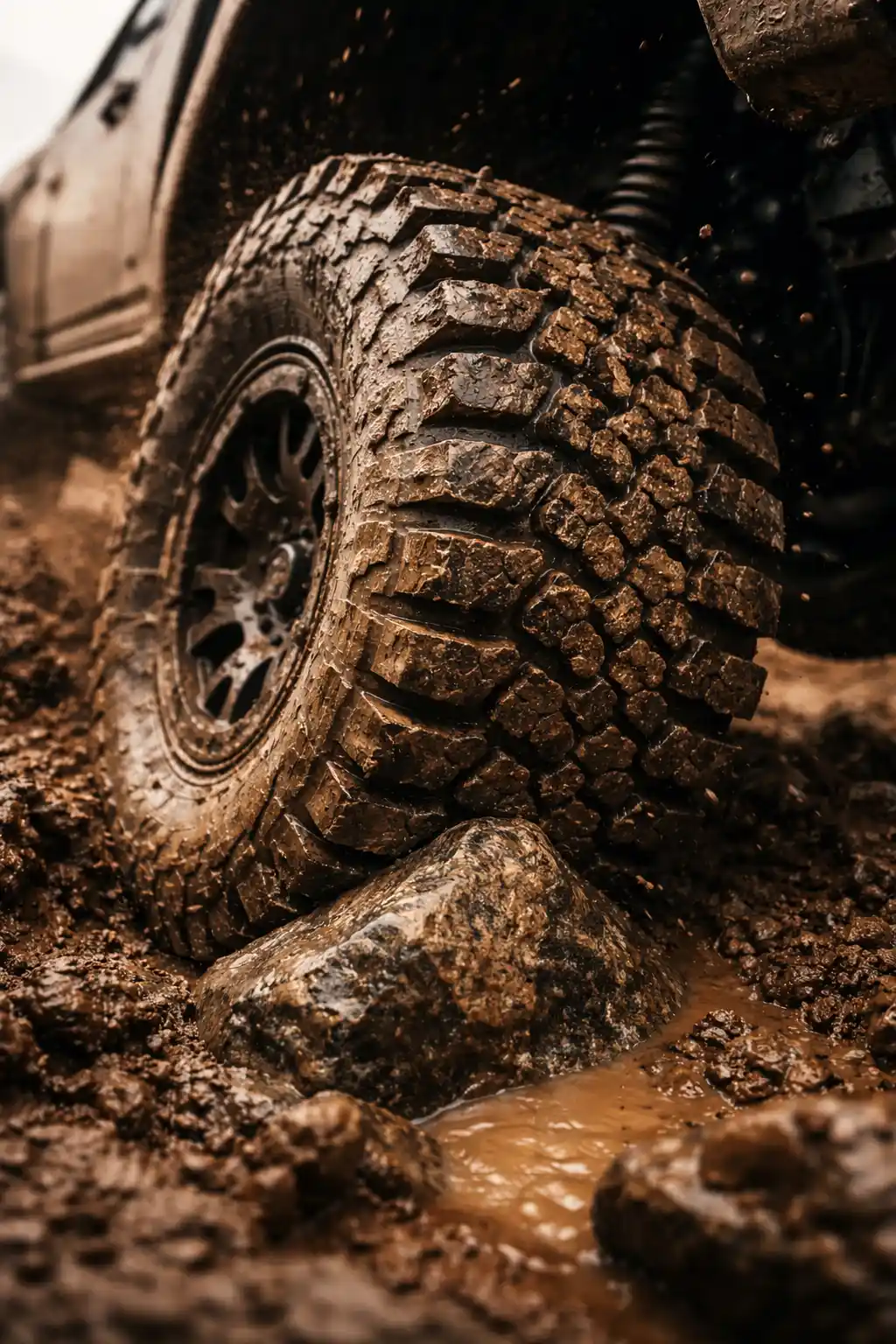
1. The Science of "Airing Down": Why Less is More
The most counter-intuitive secret of off-roading is that the air in your tires is often your enemy. On pavement, you want high pressure for stability and fuel economy. Off-road, you want the tire to act like a tank tread. This is achieved by "airing down"—lowering your tire pressure to significantly increase the "Contact Patch."
When you drop your pressure from 35 PSI to 15 PSI, the length of your contact patch doesn't just increase; it doubles. This distributes the weight of the vehicle over a larger surface area (flotation) and allows the tire to "wrap" itself around rocks and obstacles like a hand grabbing a doorknob.
📏 The Off-Road Pressure Guide
| Terrain | Suggested PSI | Why? |
|---|---|---|
| Highway | 32-38 PSI | Safety & Fuel Economy |
| Gravel/Dirt | 20-25 PSI | Vibration dampening |
| Deep Sand | 10-15 PSI | Maximum Flotation |
| Rock Crawling | 8-12 PSI | Mechanical Grip (Beadlocks recommended) |
2. AT vs. MT vs. Hybrid: Choosing Your Weapon
When you look to buy a tire online for your rig, you'll be bombarded with acronyms. Choosing the wrong one can ruin your daily commute or leave you stranded in the mud.
All-Terrain (AT)
The 70/30 choice. Great for daily driving and light trails. They have tighter tread blocks for quiet highway use but enough "void" to handle dirt and snow. Look for the 3rd-generation ATs like the BFGoodrich KO3.
Mud-Terrain (MT)
The 20/80 choice. Massive lugs and wide voids. They act like paddles in deep mud and protection against sharp rocks. Warning: They are loud on highways and have poor wet-braking performance.
The New King: The Rugged Terrain (RT) Hybrid
In 2026, the "Hybrid" or RT tire has taken the overlanding world by storm. It combines the quiet inner tread of an AT tire with the aggressive, "armored" sidewalls of an MT tire. If you are building a serious expedition vehicle that still needs to drive to the grocery store, the RT is the best tire guide recommendation we can give.
3. Sidewall Armor: The 3-Ply Myth?
Off-road, punctures don't usually happen in the tread; they happen in the sidewall. A sharp stick or a jagged piece of granite can slice through a standard street tire like butter. This is why overlanders look for "E-Load" or "3-Ply" sidewalls.
A 3-ply sidewall means the internal structure has three layers of polyester cord instead of two. It makes the tire heavier and stiffer, but it provides the puncture resistance needed when you are "aired down" and your sidewalls are exposed to the terrain. When you buy your tire online, always check the "Load Range" and "Ply Rating" in the technical specs.
🛠️ The Emergency Recovery Kit
Every overlander must carry a way to get back to pressure. Once you leave the trail, you cannot drive on the highway at 15 PSI—you will cause a blowout within minutes due to heat buildup. You need a high-flow portable compressor that connects directly to your battery, not a weak cigarette-lighter plug version.
4. The Beadlock Controversy
If you plan on running extremely low tire pressure (below 10 PSI), you run the risk of the tire "de-beading"—literally popping off the rim. Professional rock crawlers use Beadlock Wheels, which use a ring of bolts to mechanically clamp the tire to the wheel.
The Overlander's Reality: Most beadlocks are not DOT-approved for highway use. For most explorers, a high-quality "Hybrid" wheel with an aggressive "Bead Grip" inner hump is a safer and legal alternative.
5. Post-Trail Maintenance: The Mud Trap
After a weekend of fun, most drivers just hit the car wash. Big mistake. Mud can hide in your wheel barrels, creating a massive imbalance. Even 5 ounces of dried mud can make your car shake violently at 60 MPH.
Pro Tip: Always use a pressure washer to clean the inside of the rim and the valve stem area. Dirt inside the valve cap can grit up the core, leading to a slow leak that ruins your next trip.
🏁 The Final Expedition Verdict
Overlanding is about self-reliance. Your tires are your primary traction tool, your suspension's first line of defense, and your safety net. Master your tire pressure, choose a tire with a reinforced sidewall, and always carry the tools to repair and reinflate. The wilderness is beautiful, but it is unforgiving to those who ignore their rubber.
Adventure is calling. Are your tires ready? Explore our full tire guide.
*As an Amazon Associate, we earn from qualifying purchases to support our expeditions.*