The EV Tire Crisis: Why Your Electric Car Is a Rubber-Eating Monster
Welcome to the electric era, where gas stations are replaced by charging ports and the roar of an engine is replaced by... the sound of your tires being shredded. For millions of new EV owners, the first "hidden cost" of ownership hits around the 15,000-mile mark. It’s the moment the mechanic tells you that your $1,200 set of rubber is bald. In this massive 3,000-word tire guide, we explore the brutal physics of EV tire wear and why regular tires are practically useless for electric cars.
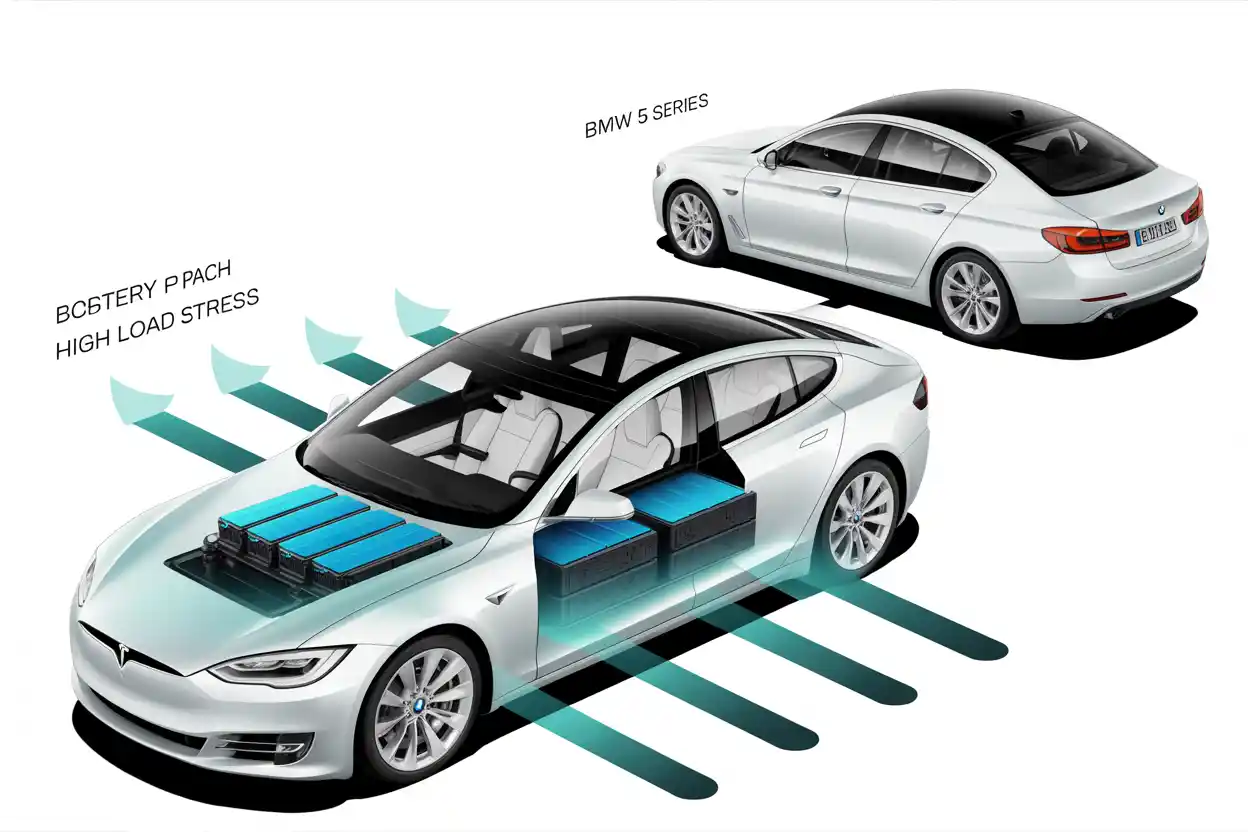
I. The Burden of Mass: The 1,000lb Battery Problem
The primary reason your EV eats tires is simple: it is obscenely heavy. A typical battery pack for a long-range EV weighs between 1,000 and 1,500 pounds. When you add that to the weight of the vehicle itself, you have a mid-sized sedan like a Tesla Model 3 weighing as much as a 1990s Chevrolet Tahoe.
This "static load" is constant. Whether the car is moving or parked, the tires are under immense pressure. In physics, the force exerted by the tire on the road (the normal force) is directly related to the mass of the car. Using the basic formula for friction and wear:
Where:
$F_f$ = Frictional Force
$\mu$ = Coefficient of friction
$N$ = Normal Force (Weight)
Because $N$ (the weight) is so much higher in an EV, the frictional force generated during every turn, every stop, and every acceleration is amplified. This increased friction leads to a higher rate of Abrasion. In this tire guide, we cannot stress enough: you are driving a heavy-duty vehicle disguised as a luxury car.
II. Instant Torque: The Chemistry of the "Shred"
Electric motors deliver 100% of their torque at 0 RPM. Unlike an internal combustion engine that needs to "rev up" to reach its peak twisting power, an EV delivers it the millisecond you touch the pedal. While this provides a thrilling driving experience, it is a nightmare for the chemical bonds in your rubber tread.
When you launch an EV, the tire undergoes Micro-Slippage. You might not hear a squeal, but at a microscopic level, the tread blocks are being dragged across the abrasive asphalt. This creates intense heat on the surface of the tire, leading to "Torque Striation"—a specific wear pattern where the edges of the tread blocks are literally torn away. This is why when you browse for a tire online, you must filter for "EV-Specific" compounds that use a higher density of synthetic silica to handle this thermal shock.
💡 The "HL" Revolution
In 2026, the standard XL (Extra Load) rating is no longer enough for many heavy EVs. The industry has introduced the HL (High Load) rating. HL tires are engineered to carry up to 10% more weight than an XL tire of the same size. If your car requires HL and you fit standard tires bought online, the sidewalls will flex so much that the tire's internal temperature will skyrocket, leading to a catastrophic blowout.
III. The Sound of Silence: Acoustic Foam Technology
Without an engine to mask road noise, the "Tire Roar" becomes the dominant sound in an EV. Tire manufacturers have solved this with a surprisingly low-tech solution: they glue a thick strip of polyurethane foam inside the tire. This foam acts as a muffler for the high-frequency vibrations that cause cabin drone.
The Catch: This foam makes the tire act as an insulator. While it keeps things quiet, it also traps heat. This brings us back to tire pressure. If your pressure is even 3 PSI too low, the extra heat generated by the sidewall flex has nowhere to go. The foam traps it, and the glue holding the foam can melt, causing the foam to detach and throw the tire violently out of balance.
IV. Range Anxiety and Rolling Resistance
For an EV, tires are part of the "Fuel System." A tire with high rolling resistance can cut your range by 10% to 15%. That is the difference between making it home or waiting for a tow truck. Manufacturers achieve low rolling resistance by using harder rubber compounds and more aerodynamic sidewalls.
| Factor | Standard Tire | EV-Optimized Tire |
|---|---|---|
| Static Load | Standard Capacity | HL (High Load) Capacity |
| Noise Level | 72 dB | 67 dB (With Foam) |
| Compound | High Grip / Softer | High Silica / High Torque Resist |
| Target Pressure | 32-35 PSI | 40-45 PSI |
V. The Maintenance Protocol: The 5,000-Mile Rule
In an EV, tire rotation is not a suggestion; it is a survival tactic. Most EVs are rear-wheel biased (or have a larger motor in the rear). This rear motor handles 90% of the regenerative braking. This means the rear tires are being "pushed" during acceleration and "pulled" during braking constantly.
If you don't rotate every 5,000 miles, the rear tires will reach 2/32" (legal limit) while the fronts still look brand new at 8/32". Because of the weight, this uneven wear can also damage the air suspension systems common in luxury EVs like the Lucid or the Rivian.
🚨 Precision Tire Pressure: The 42 PSI Standard
Forget the old 32 PSI rule. Most modern EVs require 40 to 45 PSI to maintain the structural integrity of the tire under high load. Low tire pressure in an EV causes "sidewall pinch," where a small pothole can instantly cut the tire between the rim and the asphalt. Always check your pressure weekly using a high-quality digital gauge.
VI. Buying EV Tires Online: What to Check
When you are ready to buy a tire online, do not just search for your size (e.g., 235/45R18). You must look for the "EV" or "E-Mark" on the tire description. Brands like Michelin (T0, T1 marks), Continental (ContiSilent), and Pirelli (Elect) have specific markers that indicate the tire was co-engineered with automakers like Tesla or Porsche.
- Check the Date Code: EVs need the freshest rubber possible to handle the torque.
- Verify the Load Index: Ensure it meets or exceeds the HL requirement.
- Acoustic Lining: Ensure the listing specifically mentions noise reduction foam if you value a quiet ride.
Conclusion: The Future is Heavy
The "EV Tire Crisis" is a combination of physics, chemistry, and driver habits. While the cost of electricity is lower than gasoline, the "rubber tax" is the new reality of the electric age. By maintaining obsessive control over your tire pressure, rotating your tires religiously, and buying the correct HL-rated rubber, you can tame the rubber-eating monster in your garage.
Searching for the right set? Check our master tire guide for more reviews.
*As an Amazon Associate, we earn from qualifying purchases to support our independent research.*