The 10/10ths Rule: Mastering the Physics of Track Day Rubber
In the world of everyday driving, a tire is a commodity designed for comfort, fuel economy, and longevity. However, the moment you cross the white line onto a racing circuit, the tire transforms into a high-stakes chemical weapon. At the limit—what enthusiasts call "10/10ths"—the rubber is no longer a solid object but a viscous fluid struggling to maintain structural integrity under extreme thermal load. In this definitive tire guide, we dive into the dark art of heat management, the geometry of slip angles, and the uncompromising math of high-performance grip.
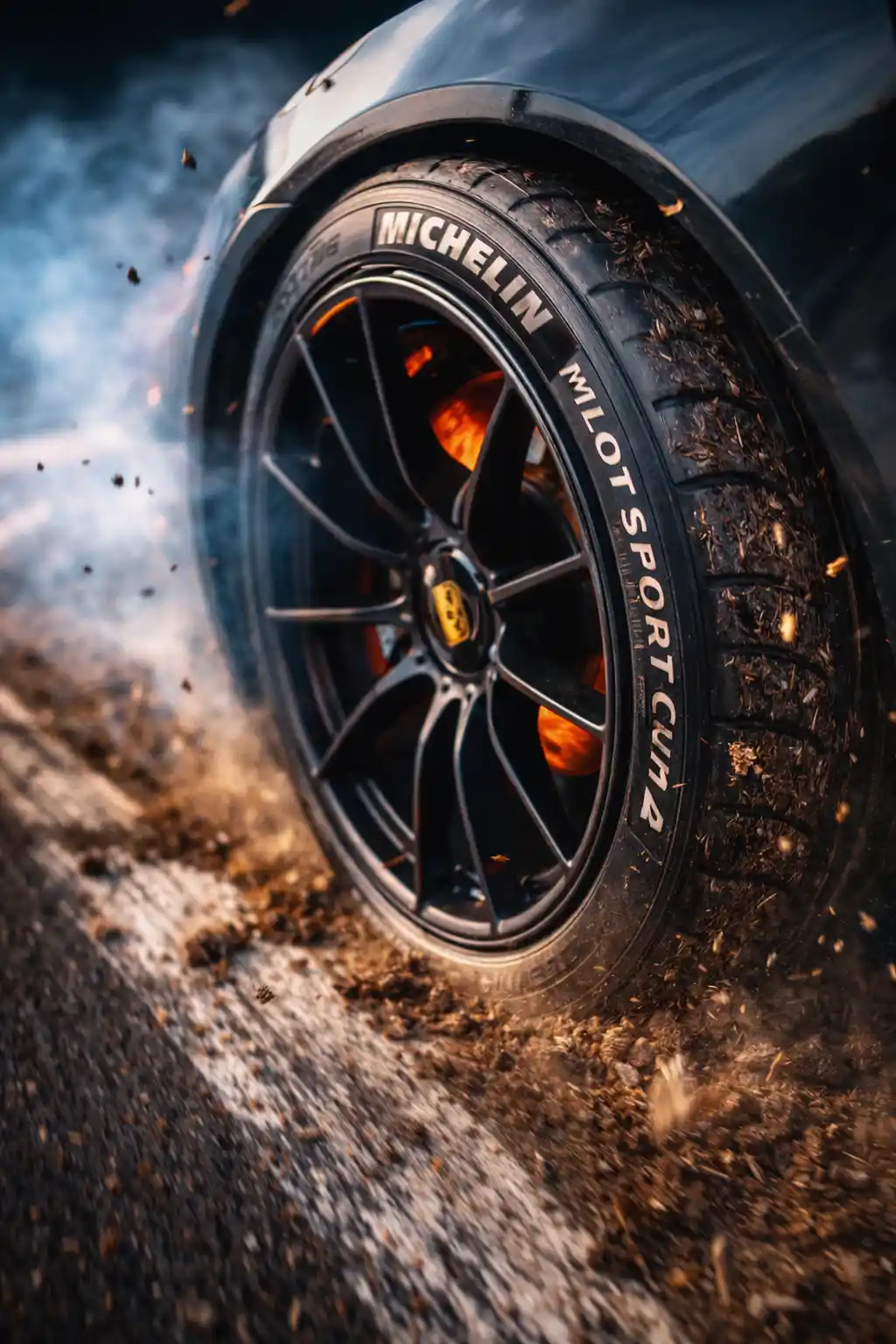
I. The Heat Cycle: The Silent Death of Performance Rubber
A common pitfall for those looking for a tire online bargain is purchasing "slightly used" track tires. While the tread depth might look nearly factory-fresh, these tires are often "heat cycled out." This is a chemical transformation, not a physical one.
A heat cycle occurs when the rubber compound is brought from ambient temperature up to its glass transition temperature (often between 190°F and 230°F) and then allowed to cool back down. During this process, the essential plasticizers and oils that keep the rubber pliable migrate to the surface and evaporate (outgassing). After a certain number of cycles, the chemical bond of the rubber becomes brittle and "glassy." The result? A tire that looks perfect but provides zero grip, essentially behaving like wood. In this motorsport tire guide, we measure age in heat cycles, not production dates.
🔥 The Pyrometer: Why Gauges Lie
Infrared thermometers (temp guns) only measure surface temperature, which cools instantly once you leave the track. To truly diagnose your car's setup, you need a needle-probe pyrometer. By measuring the temperature 1/8th of an inch inside the rubber at three points—Inside, Middle, and Outside—you can tell if your tire pressure is correct or if your camber settings are destroying your contact patch before the first apex.
II. The Slip Angle: Understanding the Elastic Limit
To the uninitiated, steering is binary. To the racer, steering is a negotiation between the wheel and the slip angle. A tire does not generate its maximum cornering force when it is pointing exactly where the car is heading. Instead, maximum lateral grip occurs at a specific Slip Angle—usually between 6° and 10° for modern high-performance radials.
The slip angle is the difference between the actual direction of travel and the direction the wheel is pointing. As the car turns, the tread "twists" and deforms. This deformation creates a "restoring force" that grips the asphalt. If you stay within the optimal slip angle, the car feels on rails. If you exceed it, the tread blocks begin to slide, generating catastrophic heat. Mastering the feel of this elastic limit is what separates a track day novice from a podium finisher.
Where $F_y$ is the lateral force, $\alpha$ is the slip angle, $F_z$ is the vertical load, and $\mu$ is the coefficient of friction. Grip is a non-linear function of heat and deformation.
III. The Cold-to-Hot Pressure Swing: Boyle's Law in Racing
One of the most frequent mistakes made after buying a performance tire online is setting the pressure to the car's door placard (factory street settings). On the track, your tire pressure is a moving target. Because of the extreme friction and brake heat transferred through the wheels, your tires can see a 10-14 PSI swing in a single 20-minute session.
The Professional Track Pressure Protocol:
- Baseline: Start your morning "Cold" at roughly 24-26 PSI (depending on the car's mass).
- The Session: Run 3-4 laps at 80% pace to bring the carcass up to temperature.
- The Bleed: Come into the pits immediately. Measure your "Hot Pressure." If it exceeds your target (usually 32-34 PSI for UHP tires), bleed the air down while the tires are still hot.
- The Consistency: Once the pressures are "set" hot, do not touch them for the rest of the day, even if they look low when cold.
IV. The Traction Circle: Longitudinal vs. Lateral Load
Every tire has a finite amount of grip. Imagine a circle: the vertical axis is braking/acceleration, and the horizontal axis is cornering. You cannot give 100% of both at the same time. If you are using 90% of your tire's grip to brake for a corner, you only have 10% left for turning. This is why "Trail Braking" is so effective—as you slowly release the brake, you "trade" that longitudinal grip for lateral cornering grip. Over-driving a tire (asking for 110%) simply results in the rubber overheating and "greasing over."
V. Decoding the DOT-R: The 200 Treadwear Revolution
When you browse a tire online, you'll see the UTQG (Uniform Tire Quality Grade) rating. For track enthusiasts, the magic number is 200. The "200 Treadwear" class (like the Michelin Pilot Sport Cup 2 or Bridgestone RE-71RS) represents the bridge between street legal and racing slicks.
These tires utilize "sticky" resins that require a specific temperature window to activate. Below 60°F, they can be dangerously slick. Above 240°F, they begin to "delaminate." Unlike standard tires, these often feature reinforced sidewalls to prevent the tire from "rolling over" the rim during 1.2+ G corners. If you are moving from a standard 300TW tire to a 200TW or below, your tire pressure management must become surgical.
🏁 The "Graining" Mystery
Do your tires look like they've been chewed by a dog? That's Graining.
Graining occurs when the surface of the rubber gets hot enough to soften, but the internal carcass is still cold. The rubber literally tears off in small "rolls" because the structure cannot support the surface grip. To avoid this, take at least two full laps to build heat progressively through the entire tire before pushing for a personal best.
VI. Post-Track Care: Preserving Your Investment
After a weekend of abuse, your tires need care. The "marbles" (small chunks of hot rubber) that stick to your tread will cause massive vibrations on the drive home. More importantly, storing high-performance rubber in a freezing garage will cause "cold cracking." These compounds are brittle when cold; always store your track tires in a climate-controlled environment during the off-season to ensure they don't develop structural fractures.
🚀 The Complete Pro Toolkit: Gauges, Probes & ChalkPushing the limits? Do it safely. Explore our full tire guide catalog for more technical deep dives.
*As an Amazon Associate, we earn from qualifying purchases to keep our technical research independent.*