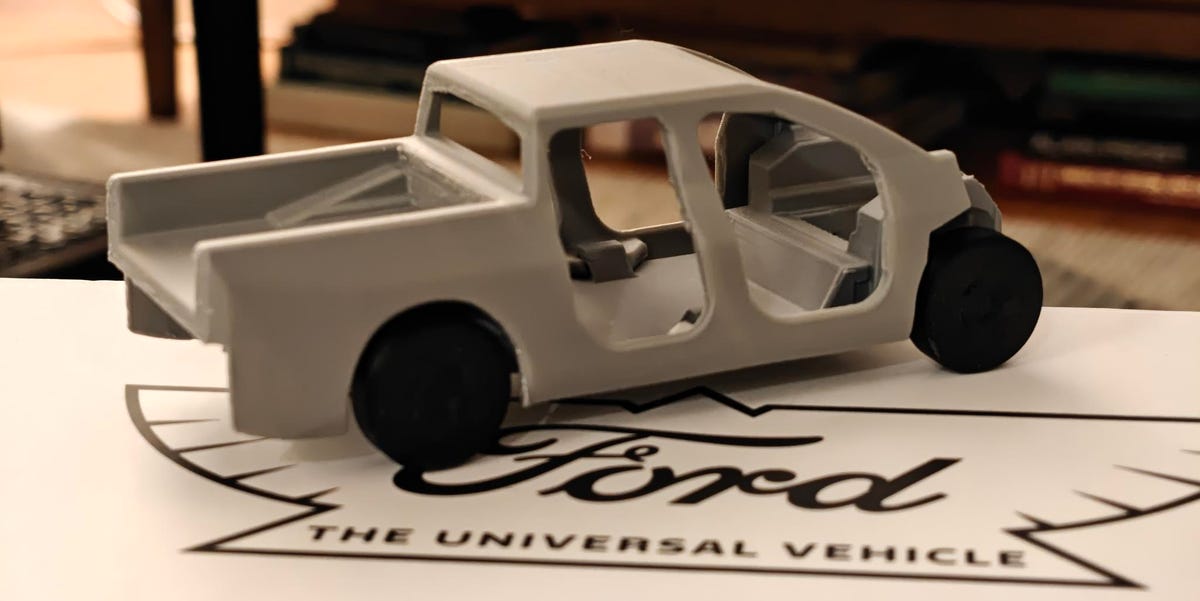
We recently journeyed to Long Beach, California, for an exclusive look at how Ford is revolutionizing its electric vehicle engineering process.
Ford has already unveiled the key details and vital headlines for its eagerly anticipated electric midsize pickup. This new truck is touted as a potential "Model T moment," expected to be priced around $30,000, offering ample range and a wealth of cutting-edge technology. From its development methodology to its assembly process, everything about this truck is fresh and innovative for Ford, signaling what appears to be a true revolution within the Blue Oval.
Naturally, there's much more to explore, so Ford invited Road & Track into its highly confidential Electric Vehicle Development Center (EVDC) in Long Beach, California. Our mission: to get an insider's view of how this groundbreaking new EV platform is being engineered. And before you wonder, yes, we did catch a glimpse of the truck itself—though it was brief, and the prototype was heavily cloaked in thick camouflage.
The facility in Long Beach, where this new EV and several future models sharing the same platform are being developed, is discretely located near the local airport. It comprises two distinct structures, necessitating a short walk between them. It was during this very walk that Ford cleverly drove a prototype of the truck past us. Spoiler alert: it undeniably looked like a truck. However, the camouflage certainly concealed a design that promises to differentiate it significantly from other Ford pickups.
We infer this because Ford has hinted at aerodynamics playing a monumental role in the pickup's design. Additionally, Ford sent us home with a unique souvenir: a rudimentary 3D-printed model of the truck, crafted at the EVDC. This model vividly showcases the extraordinary aspects of the truck's platform and construction. It arrived disassembled but divided into the "unicastings" Ford plans to utilize for the production pickup. This innovative platform strategy marks a first for Ford and draws inspiration from the "gigacasting" techniques Tesla has already implemented in its manufacturing.
 View Price on Amazon
Beyond its construction, this model provides our clearest view yet of the electric pickup’s exterior design. While most of the front end is absent, the acute angle of the windshield strongly indicates a highly aerodynamic design. The leading edge of the roof maintains this aggressive angle before leveling out much like a traditional truck. Another clear indication of its aerodynamic focus can be seen in the bedsides, specifically their distinctive chamfered design. No other pickup currently on the market features bedsides quite like these, and we're truly eager to see how this translates into actual sheetmetal.
The undeniable advantages of such a streamlined design mean Ford can incorporate a smaller battery pack. Akshaya Srinivasan, director of range, performance, and battery systems modeling, informed us that the battery constitutes 40 percent of Ford’s total vehicle cost. Therefore, a smaller pack directly translates to a more affordable truck. Ford is developing its powertrain system entirely in-house for this platform, granting it the flexibility to constantly adjust parameters. If the design team discovers a method to further reduce drag, the battery team can implement changes swiftly.
A significant focus for the UEV platform is also finding ways for parts to serve multiple functions. For instance, the inverter shares the same housing as the electric motor, enabling Ford to use a single cooling circuit for both the motor and the semiconductors within the inverter.
Another clever innovation Ford unveiled is a new strategy for its climate control system. "We also have a new piece of technology that's new to Ford, called our hot gas bypass loop," explained Mitch Shinn, ADVEV thermal systems engineering manager. "Effectively, the way that works is you are taking refrigerant, going into your compressor, you compress it, comes out, and then you immediately bring it back in. So you're able to produce heat, just using a compressor, and it allows us to completely delete the typical resistance heater that you have in this system."
Shinn elaborated on Ford's philosophy: "It's part of our philosophy of, [the] best part is no part. The second best part is a part that serves multiple purposes, which is our compressor.”
Source: roadandtrack.com

