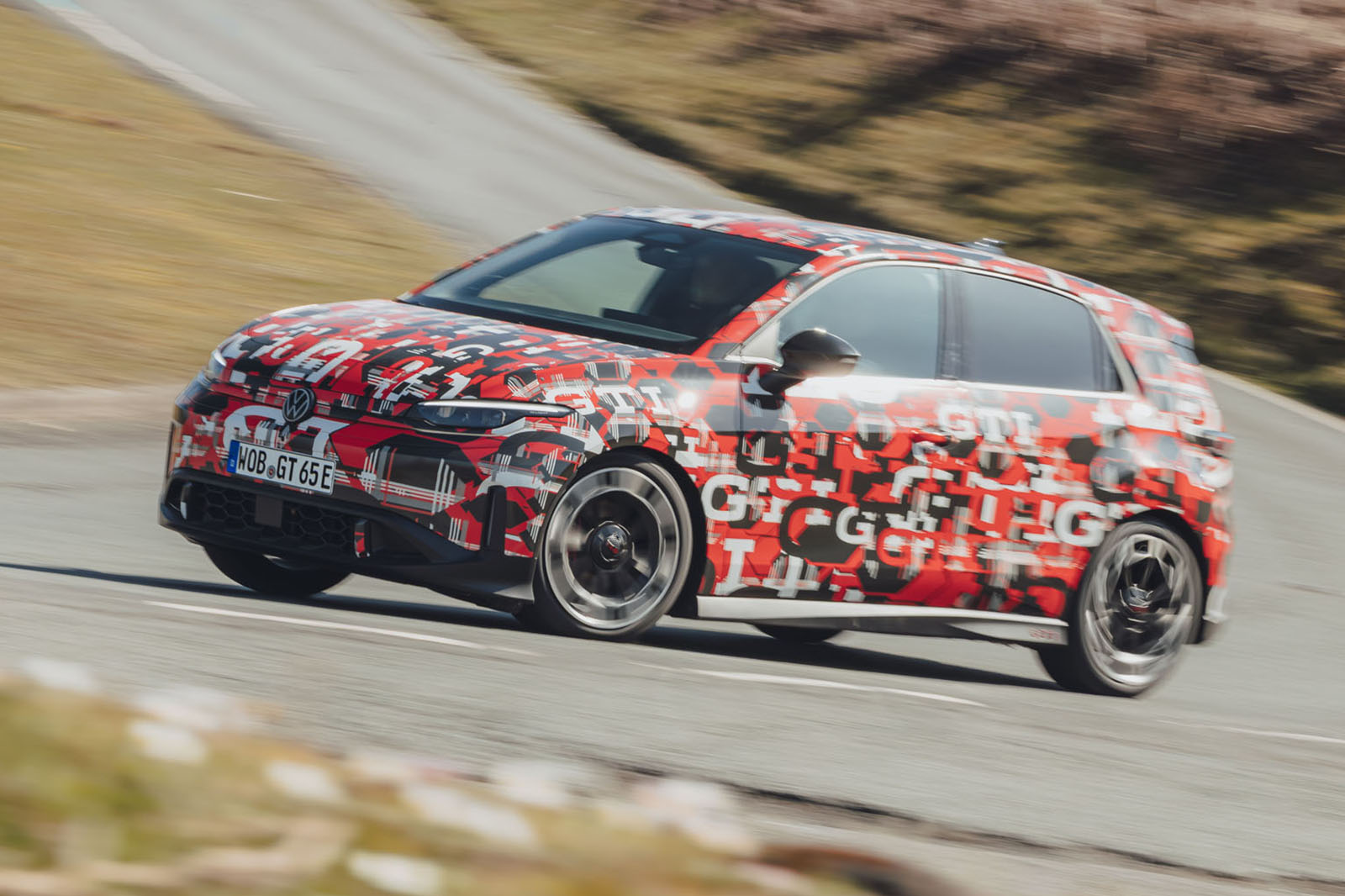
Volkswagen’s GTI performance subbrand, for so long a tower of strength for the company, has turned into something of a problem for it over the past decade.
With its GTE and GTX models, Wolfsburg has tried various approaches to complement, augment, or otherwise update those three famous letters, or else just gently steer the idea that they represent in the direction of electrification. So far, gentle steering hasn’t done the trick.
But the tiptoeing and pussyfooting around is finally over. Bolder and more radical decisions have been taken. And, in a gravel car park in the Brecon Beacons, I’m standing next to the proof.
The seventh-generation Polo subcompact, due this year, is going electric. Volkswagen is signaling this development clearly and loudly, by adding an ID. prefix to the car’s name (it will do the same with many other familiar models over the next couple of years), but what it’s giving us is pretty plainly a Polo all the same.
It’s part of a more comprehensive commitment to making EVs central within the company’s model portfolio, instead of being peripheral or parallel to it. There’s a seriousness about electric mobility here that Volkswagen hasn’t quite shown before.
And the icing on the cake for this shift in attitude is the first electric GTI model: the ID. Polo GTI. Crucially, it’s not a GTX (how the ‘performance’ versions of the ID.3, ID.4, ID.5, ID.7 and ID. Buzz have been badged so far), it’s a GTI – mostly as we have known the idea of one since the 1976 Mk1 Golf GTI.
Top-tier yet practical; desirable but usable; fast and fun but not overly aggressive or difficult to drive. A regular, versatile, everyday car with superpowers, not compromises – and a fully realized, top-tier driver's car to boot.
The very first ones won’t reach German customers until late 2026, with U.S. deliveries anticipated in spring 2027. So as we stand here, the April sun warming our mountain retreat, the development team for the car – led by Volkswagen’s head of driving dynamics, Florian Umbach – is still in the final stages of software tuning.
That team has come to the UK with serious intent, however – and not only to partner with Autocar, making us the world's first testers to drive the new GTI.
 View Price on Amazon
“We know how important the U.S. market will be to the success of this car,” explains Umbach, “and also how particular, unique, and challenging your roads are. This is the heartland of hot hatchbacks. It has been such a pivotal market for these types of vehicles. So I always had it in mind to bring prototypes here to ensure they would perform well. That’s what today is about.”
Cupra may have led development of this electric subcompact, but Volkswagen insists that it’s a proper Polo
Before the driving, Umbach gives me a guided technical tour of the vinyl-wrapped EV in front of us. Even so thoroughly disguised, it looks much more like a familiar, conventional hatchback than the ID.3 has ever looked.
This generation of cars, he says, will be all about Volkswagen getting back to its roots, rediscovering its core priorities. “The ID. Polo simply had to look normal – like a Volkswagen,” says Umbach with a smile. “And so, technically, it has a familiar layout and lots of technologies that you recognize. But it’s still an advanced compact car.”
Volkswagen’s internal codename for the new EV platform on which the ID. Polo is based (in development since 2021, as you might guess) is MEB21, says Umbach, but it has been rebranded for public consumption as the catchier-sounding MEB+ platform.
It confers a conventional hot hatchback layout on the GTI: a front-mounted motor driving the front wheels, with strut-type front suspension and a torsion beam rear axle.
“The MEB-generation EVs (like the ID.3) taught us that switching to a rear-motor layout means adding weight (to engineer in sufficient crash protection) and sacrificing trunk space in compact cars,” explains Umbach.
“By contrast, MEB+ makes the ID. Polo lighter, simpler and more efficient. We can carry e
Source: autocar.co.uk

