Aston Martin’s crucial, if perhaps unexciting, current business plan, devised by boss Adrian Hallmark in 2024, is ostensibly to better utilize the company’s assets. The strategy aims to plan smarter, do more with less, and launch more higher-value 'special' derivatives of its series production models, alongside ultra-exclusive, collector-grade models like the Valour and Victor.
Given the state of the company’s share value, you might question how well that plan is currently working. However, we have, at least, already seen a range-topping DBX S, a conceptually similar Vantage S, and now this Aston Martin DB12 S: all representing higher-value, special derivatives.
Aston Martin boasts a history of even faster models with 'S' badges stretching back to the DB3 S of 1953, but it has never before deployed them as widely or consistently as now. The S version of the first, early 2000s-era Vanquish was ostensibly a facelift; a reason for dealers to call up Vanquish owners and invite them to part with another five- or six-figure sum. However, the S suffix was used more like it will be from now on within the lineage of the smaller Vantage performance car; as an addition to the range and an expansion of the performance envelope these cars can ultimately achieve, rather than as a mid-cycle refresh.
Consequently, the standard DB12 remains in the lineup after the introduction of this new addition (just as the equivalent Vantage did last year). Aston insiders even talk of the opportunity to re-evaluate the base model's position slightly, serving as a counterpoint to its new, sportier sibling – though it remains to be seen if customers will still opt for "the lesser model" when they can invest more in an S version, gaining that crucial extra bit of prestige.
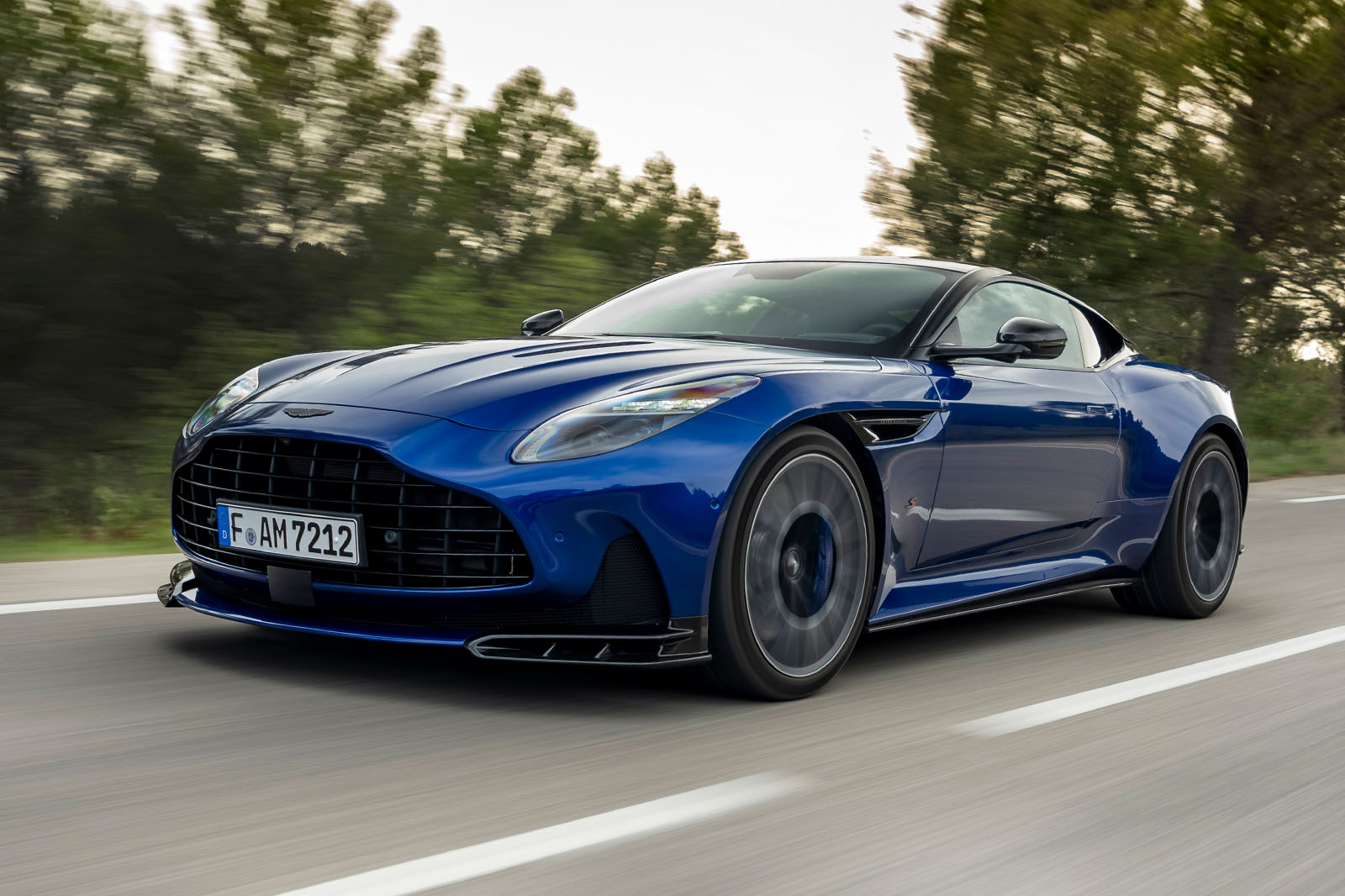
The performance enhancements applied here are predictable in their agenda, but also quite detailed and wide-ranging. It starts with the DB12’s AMG-sourced 4.0-liter twin-turbo V8, which is recalibrated for a broader torque curve and headline horsepower boosted by 20 hp, bringing the total to 691 horsepower. An updated eight-speed transaxle automatic transmission puts that power to the road via a recalibrated torque-vectoring Bosch ‘E-Diff,’ and then the rear wheels. Even with these upgrades, it only helps contribute to a 0-62 mph acceleration time reduced by a tenth of a second compared to the standard DB12.
 View Price on Amazon
Meanwhile, the chassis upgrades include Bilstein DTX adaptive dampers, retuned to take advantage of the reduction in unsprung mass from the standard carbon-ceramic brakes. Aston Martin claims these make the car’s body control more linear and ultimately more effective, allowing greater wheel travel at low speeds while also improving outright body control at higher speeds.
At the rear axle, a stiffer anti-roll bar has been fitted, while revised wheel geometry introduces enough negative camber to be visibly apparent even when the car is parked. These changes, in turn, give the front wheels a more robust platform for turn-in, sharpening cornering agility while simultaneously improving rear-axle stability. Revisions to the EPAS power steering system upfront are designed to deliver improved off-center steering precision and tactile feel.
The DB12 S's bodywork also receives noticeable yet understated revisions. The standard chin spoiler, side sill extensions, and additional hood louvers are integrated, and a subtle fixed lip spoiler on the trunk lid (there in place of the standard DB12’s 'aeroblade' active aerodynamic system) helps to compensate for the added weight of the enhanced, F1-style aero ducting around the bumper corners.
The net effect is that, including the carbon brakes, the DB12 S weighs 84 pounds less than a standard DB12 without any factory options. If you opt for Gaydon’s new lightweight titanium active sports exhaust (both it and the standard steel one feature a new ‘stacked’ quad pipe look), you can increase that weight saving to just under 110 pounds. While certainly not a revolutionary reduction, it’s still a noteworthy improvement, even on a GT car weighing over 3,968 pounds.
Source: autocar.co.uk