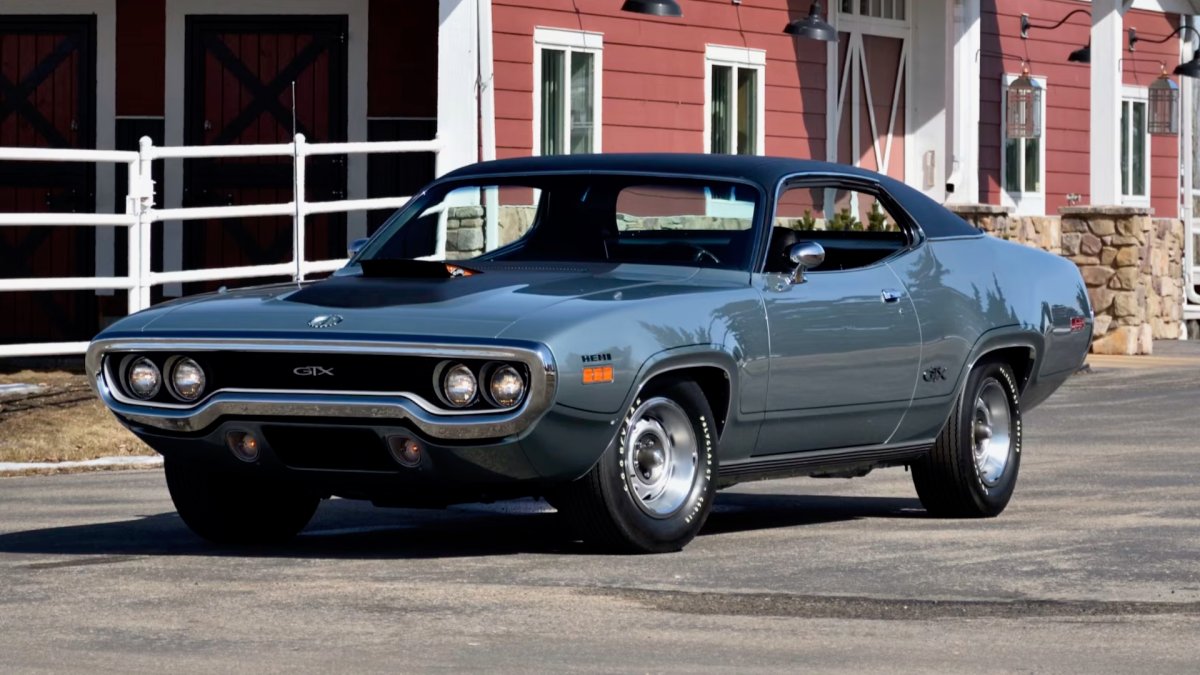
The roar of American muscle cars is about to echo through Mecum's 2026 Indianapolis auction, and among the automotive legends crossing the block is a truly exceptional relic: a 1971 Plymouth Hemi GTX. This isn't just any GTX; it's a profound statement from the twilight of the original muscle car era, a car so rare it practically defines scarcity.
According to Mecum, this specific GTX is one of an astonishingly small batch—just 11 examples from 1971—to combine the colossal 425-horsepower, 426-cubic-inch Hemi V8 with a coveted four-speed manual transmission. Its exclusivity deepens even further as one of only four equipped with the performance-boosting Super Track Pack, which included aggressive 4.10 gearing and a Sure Grip limited-slip differential. To top it off, it's believed to be the sole 1971 Hemi GTX finished in the distinctive Winchester Gray, making it a potential unicorn for collectors.
Beyond its powertrain and paint, this GTX is a prime example of well-appointed performance for its time. It boasts power steering and power brakes, comfortable bucket seats, and the iconic Mopar Rallye wheels wrapped in Goodyear Polyglas tires featuring prominent white lettering. A standout visual cue is the distinctive Air Grabber hood, which replaces a fixed scoop with a pop-out slot, ready to gulp air. The vehicle has also undergone a meticulous rotisserie restoration, crucially retaining its numbers-matching engine and transmission—a detail paramount for serious collectors.
 View Price on Amazon
Long before Volkswagen borrowed the moniker for its European-market electric cars, GTX proudly stood for American muscle. Introduced in 1967, Plymouth's GTX followed the classic formula: shoehorn a potent V8 into a mass-market chassis. Positioned as a more upscale option, it carved out space for the more budget-friendly Road Runner (launched on the same Chrysler B-Body platform a year later) and gave Plymouth a formidable contender against rivals like the Pontiac GTO and Oldsmobile 442. Like many Mopar muscle machines, it could be optioned with the robust 440-cubic-inch V8, but the Hemi was always the pinnacle.
The GTX, alongside other B-Body models, received a controversial yet visually striking redesign for 1971, adopting the new 'fuselage' design language. In my humble opinion, these cars had a captivating flair often underrated. However, this aesthetic evolution coincided with a seismic shift in the automotive landscape. Automakers were bracing for new emissions regulations, and insurance companies began to recognize that powerful, affordable cars were a bad gamble. With its industrial-strength 426 Hemi, the 1971 Plymouth Hemi GTX was unequivocally the closing chapter of an epoch. Within a few short years, those magnificent big V8s would be severely detuned or vanish entirely.
Though the Plymouth brand itself has faded into history (even the Prowler couldn't revive it), the legend of the Hemi endures. Mecum anticipates this extraordinary machine will command a price between $325,000 and $350,000 when it crosses the block on May 15th. For perspective, a numbers-matching 440 GTX with a manual transmission, selling on the same day, is estimated at a mere $110,000 to $130,000. Such is the undeniable power of ultimate rarity and historical significance.
Source: thedrive.com

