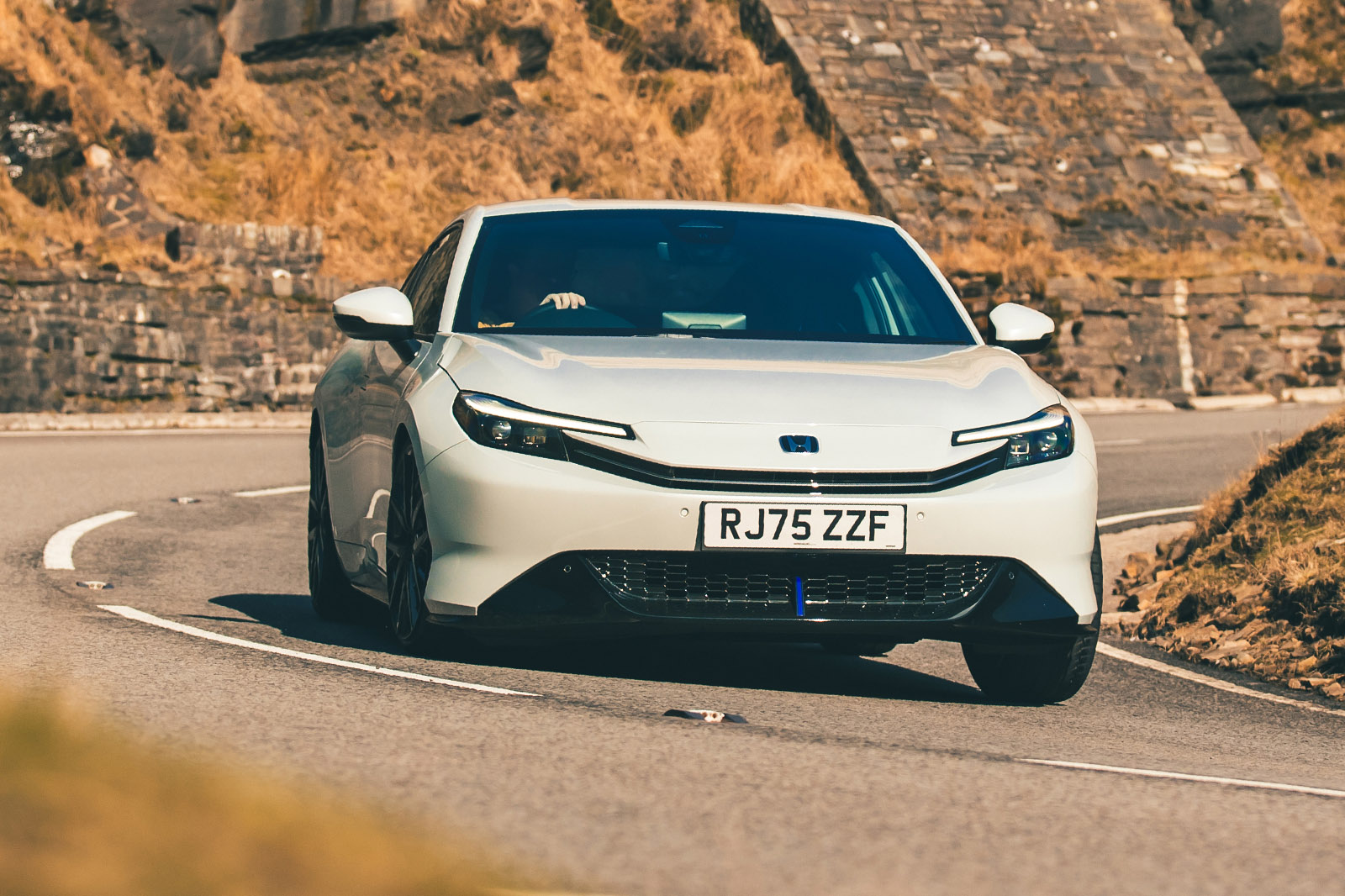
Given the trend of modern vehicles like the new Ford Capri, you might be excused for thinking that Honda's revival of the Prelude after more than 20 years would inevitably result in a crossover. Fortunately, that hasn't happened. This fifth interpretation of a nameplate set to celebrate its 50th anniversary in 2028 is, like all its predecessors, a front-wheel-drive coupe.
We've spent a significant amount of time with the new Prelude – certainly enough to appreciate its charms as a relatively affordable, fuel-efficient, and practical junior GT. As we'll soon explore, labeling this 179-horsepower, hybrid-powered machine an outright sports car might be a stretch. There are indeed areas where it can't quite compete with the similarly priced BMW 2 Series 220i M Sport. However, when viewed through the right lens, there's plenty to admire here, so let's dive in.
Beneath its strikingly styled 14.8-foot body are the underpinnings from the Civic Hybrid, albeit featuring the dual-axis front-strut design of the outgoing Civic Type R (though not identical, as the geometry differs). These struts are engineered to mitigate torque steer, a valuable feature in the 312-hp Type R, but perhaps less critical in the Prelude, which produces just 179 hp from its hybrid powertrain. Still, innovation has always been part of the Prelude’s DNA—earlier iterations included rudimentary front-axle torque vectoring as well as mechanical four-wheel steering—so the inclusion of interesting engineering is a welcome touch.
"Honda says the Prelude's shape was inspired by a glider. With its gently sloping rear end, I can definitely see the resemblance. Let's assume it doesn't have a glider's aerodynamics, though."
— Illya Verpraet, Road Test Editor
In 2026, most of the complexity concerns the powertrain, which utilizes Honda's familiar e:HEV setup. The combustion element is a 2.0-liter Atkinson-cycle engine, capable of directly driving the front wheels via a lock-up clutch (often engaged at higher speeds). Typically, however, it powers a generator that produces electricity, which is then routed through a 1.06 kWh battery pack and to the drive motor that spins the front wheels through a fixed gear ratio (no CVT pulley here). Most of the time, the car's traction motor is propelling you, not the engine.
 View Price on Amazon
This series-hybrid setup is similar to the Civic Hybrid, though the Prelude boasts a feature known as S+ Shift. In this mode, the driveline simulates gearshifts, which you can engage using the premium-feeling metal paddles located behind the steering wheel. It's a philosophy akin to that of the Hyundai Ioniq 5 N, but with an actual combustion engine providing the accompanying soundtrack.
The Prelude's interior largely borrows from the Civic but infuses added charm. The dashboard and center console are a bit more sculpted yet still retain plenty of physical controls. Opting for the blue-and-white interior color scheme also gives the Prelude some added flair that brightens its demeanor compared to a BMW 2 Series, and any gloss black surfacing is used sparingly. It’s smart yet fun, and distinctly Japanese.
In terms of ergonomics, the driving position isn't any lower than in the Civic, so the Prelude doesn't immediately deliver that true sports car feel, unlike a BMW or a Mazda MX-5. The part-electric seats are nonetheless a bit sportier than those found in the five-door Civic hatchback, providing more lateral support for the driver. Curiously, in the new Prelude, the front passenger seat differs from the driver’s, offering a slightly softer cushion and shorter side bolstering.
"The infotainment system is the same as in other Hondas. It's intuitive enough, doesn't dominate, and includes wireless smartphone mirroring, but admittedly feels quite dated."
— Richard Lane, Deputy Road Test Editor
This is a compact coupe, so don’t expect too much from the rear seats, which are truly designed as an afterthought, much like those in a Porsche 911. They are useful for emergencies, but adults won’t want to spend any length of time back there. Young children, however, will find them far more accommodating, and might even enjoy having the large rear screen above their heads.
Source: autocar.co.uk